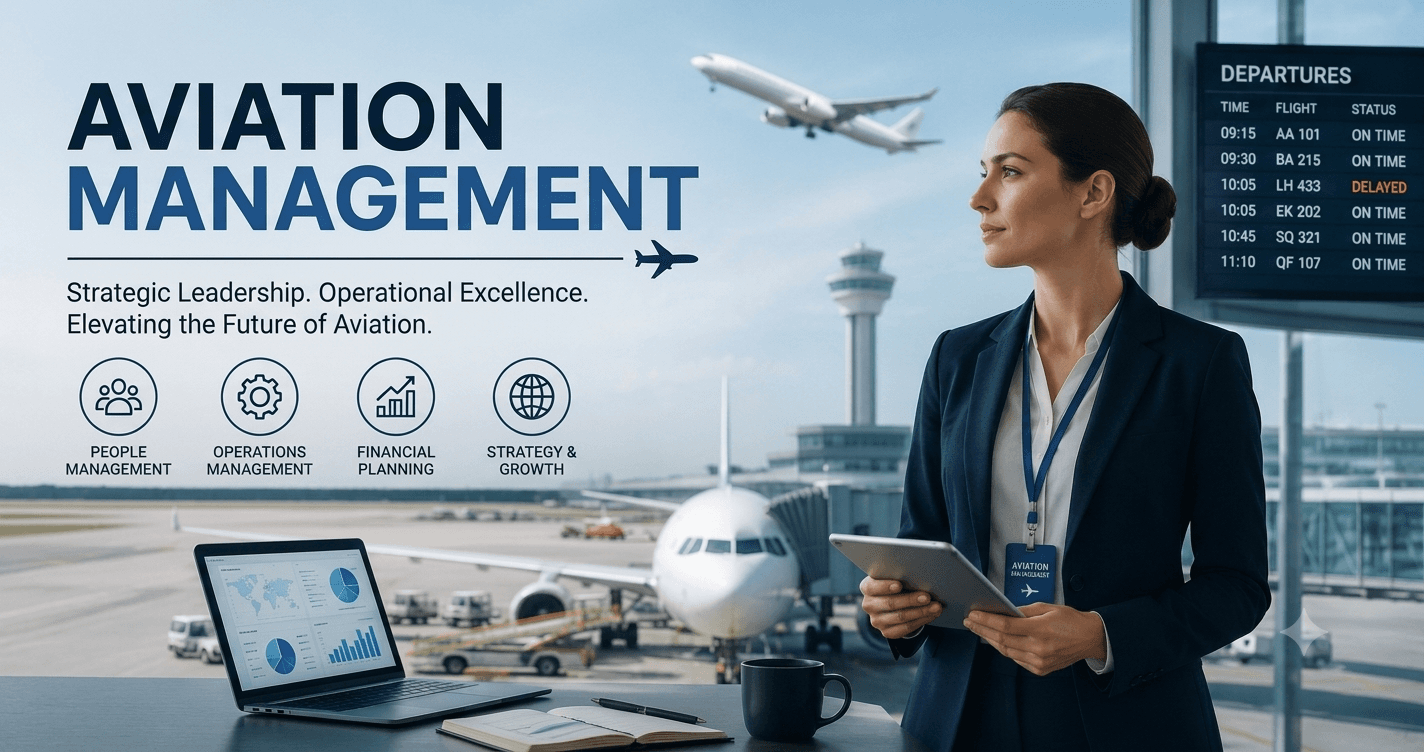
From Takeoff to Landing: Understanding the 5 Core Pillars of Aviation Management
Discover the 5 essential pillars of aviation management and explore career opportunities in the aviation industry with professional training
EXATECH Faculty
June 24, 2026
Introduction
Aviation is often called the "nervous system" of the global economy. Every day, over 100,000 flights carry 12+ million passengers and billions of dollars of cargo. But how does it all stay organized?
Let us explore the 5 pillars of Aviation Management.
The 5 Pillars Explained
1. Airport Operations
This is the visible part of aviation—what passengers see.
- · Includes: Terminal management, passenger flow, baggage handling, security screening, gate assignments, and ground handling (refueling, catering, cleaning).
- · Key metric: On-time performance (OTP). If the plane is at the gate but passengers are stuck in security, OTP fails.
2. Airline Management
This is the business side of flying.
- · Includes: Route planning, fleet assignment, crew scheduling, revenue management (pricing those seats), and marketing.
- · Key concept: Load factor (percentage of seats filled). A flight with 80% load factor is profitable; 60% is losing money.
3. Air Traffic Control (ATC) & Navigation
The invisible heroes who ensure planes don't collide.
- · Includes: Ground control (movement on runways/taxiways), tower control (takeoff/landing), and en-route control (guiding planes between cities).
- · Key fact: There is no "driving lane" in the sky. ATC creates virtual highways at different altitudes (e.g., eastbound planes at odd altitudes, westbound at even).
4. Safety & Security
Non-negotiable in aviation.
- · Includes: Aircraft maintenance schedules, cockpit resource management, passenger screening (TSA/CISF), and emergency response planning.
- · Key authority: ICAO (International Civil Aviation Organization) sets global standards. IATA adds operational guidelines.
5. Regulatory & Legal Compliance
Aviation is one of the most regulated industries on Earth.
- · Includes: Airworthiness certificates, pilot licensing, environmental regulations (noise and emissions), passenger rights (compensation for delays).
Title: Beyond the Pilot: 7 High-Demand Aviation Careers You've Never Heard Of
Introduction
When people think "aviation career," they picture pilots and flight attendants. But for every pilot, there are 30+ professionals working behind the scenes. Here are 7 high-demand, well-paying roles you should consider.
The Hidden Careers
1. Aviation Dispatcher (Flight Operations Officer)
- · What they do: Co-pilot on the ground. They create the flight plan, calculate fuel needs, monitor weather, and have legal authority to delay or cancel a flight.
- · Salary range: $50,000–$90,000
- · Training: Requires aircraft dispatch license (not a pilot's license).
2. Airport Duty Manager
- · What they do: The "CEO of the terminal" for 8 hours. Handle irate passengers, broken escalators, security breaches, and medical emergencies—sometimes all at once.
- · Key skill: Crisis decision-making under pressure.
3. Revenue Management Analyst
- · What they do: Use algorithms to decide that seat 14A costs $300 today but $500 tomorrow because a conference just announced its dates.
- · Key tool: Yield management software. This role directly impacts airline profitability.
4. Ramp Agent (Ground Handler)
- · What they do: Work on the tarmac—loading bags, guiding planes into gates, operating belt loaders, and de-icing wings.
- · Career path: Start as ramp agent → shift supervisor → ground operations manager → airport director.
5. Aviation Safety Inspector (Regulatory)
- · What they do: Work for civil aviation authorities (FAA, EASA, DGCA) inspecting maintenance records, pilot training logs, and airline procedures.
- · Job security: Extremely high. Regulators always need inspectors.
6. Cargo Operations Coordinator
- · What they do: Manage the belly space of passenger planes and dedicated freighters. Ensure dangerous goods (batteries, chemicals) are packed correctly.
- · Growth area: E-commerce (Amazon, DHL, FedEx) is exploding.
7. Air Traffic Controller (ATC)
- · What they do: Use radar and radio to separate planes by 1,000 feet vertically and 3 miles horizontally.
- · Important note: High stress, but also high pay ($80,000–$160,000) and early retirement options.
******************************************************************************
The Future of Hotel Management: Trends to Watch
The hotel management industry is standing at the edge of a transformation unlike anything seen since the rise of branded chain hotels in the 1950s. As guest expectations evolve, technology accelerates, and global challenges reshape travel patterns, hotel managers who fail to adapt risk becoming obsolete within the next five years. So, what does the future actually look like? Let us explore the most important trends that every hotelier and hospitality student needs to watch closely.
First and foremost, hyper-personalization driven by artificial intelligence is no longer a luxury but a baseline expectation. Guests have grown accustomed to Netflix recommending shows and Spotify curating playlists, and they now expect their hotel experience to feel equally tailored to their preferences. Future hotel management systems will use AI to remember that a returning guest prefers a firm pillow, a room on a high floor away from the elevator, a mini-fridge stocked with oat milk rather than dairy, and the thermostat set to 19 degrees Celsius at bedtime. This goes beyond simple loyalty program data; it involves predictive analytics that anticipate needs before the guest even articulates them. For example, if a guest frequently orders room service at 10:00 PM during previous stays, the hotel system might automatically send a push notification at 9:30 PM offering their usual order with a one-click confirmation. The hotel manager of the future will spend less time handling complaints about forgotten preferences and more time overseeing the algorithms and data privacy protocols that make this seamless experience possible.
The second major trend reshaping hotel management is the continued rise of contactless and mobile-first operations. The COVID-19 pandemic accelerated a shift that was already underway, and there is no going back. Modern guests increasingly expect to complete their entire journey without interacting with a single human being if they choose not to. This means mobile check-in via the hotel's app, a digital room key that lives on their smartphone, voice-activated controls for lighting, temperature, and television, and the ability to text housekeeping requests or front desk inquiries rather than calling or visiting the lobby. Some forward-thinking hotels have already eliminated the traditional front desk entirely, replacing it with a small team of roaming guest experience associates armed with tablets who can check guests in from anywhere in the lobby while offering a welcome drink. For hotel managers, this trend shifts the skill set required for success; instead of managing long queues at the front desk, managers must now ensure that WiFi is flawless, mobile apps are bug-free, and staff are trained to provide warm, efficient service through digital channels without losing the human touch that hospitality is built upon.
Third, the blurring line between business and leisure travel, a trend widely known as "bleisure," is fundamentally changing how hotels design their spaces and manage their inventory. Millions of professionals now work remotely, and many have realized that they can answer emails from a beachfront resort just as easily as from their home office. This means that Tuesday and Wednesday nights, historically the slowest nights for leisure-focused hotels, are now filling up with remote workers who book longer stays that combine workdays with weekend getaways. In response, forward-looking hotels are redesigning their rooms and common areas to accommodate this new guest. Gone are the tiny desks tucked into a corner; in their place are ergonomic workstations with multiple power outlets, monitor hookups, and lighting designed to reduce eye strain. Some hotels now offer "work from hotel" day passes that grant access to meeting rooms, high-speed WiFi, and unlimited coffee even to guests who are not staying overnight. Hotel managers must also rethink their housekeeping schedules, as bleisure travelers often stay four or five nights and prefer cleaning every other day rather than daily. Pricing strategies are evolving too, with hotels offering discounted weekly rates specifically targeted at remote workers who might otherwise book an Airbnb.
The fourth trend that hotel managers cannot afford to ignore is the growing demand for authentic, local, and sustainable experiences, often called the "anti-hotel" movement. Generic beige carpets, identical breakfast buffets, and corporate art prints no longer impress today's travelers, who crave uniqueness and connection to the destination they are visiting. This has given rise to boutique hotels where every room is decorated differently, conversion hotels housed in repurposed factories, prisons, or churches, and lifestyle hotels that partner with local coffee roasters, artists, and musicians to create a sense of place. Even massive global chains like Marriott and Hilton have responded by launching "soft brands," which are collections of independent hotels that retain their individual character while gaining access to the chain's distribution and loyalty program. For hotel managers, this trend means moving away from rigid corporate standards toward a more flexible, curated approach. The general manager of the future will spend less time enforcing brand compliance and more time building relationships with local suppliers, organizing neighborhood walking tours led by staff members, and curating a minibar that features locally made snacks and drinks rather than national brands. Sustainability is a critical component of this trend, with guests increasingly willing to pay a premium for hotels that have eliminated single-use plastics, installed solar panels, implemented water recycling systems, and achieved certifications like Green Key or LEED.
Finally, the future of hotel management will be defined by a shift in workforce strategy and talent development. The hospitality industry has long struggled with high turnover rates, often exceeding seventy percent annually for front-line positions, and the pandemic only worsened this problem as many experienced workers left the industry entirely. The hotels that thrive in the coming years will be those that treat their employees as assets to be developed rather than as costs to be minimized. This means cross-training staff across multiple departments so that a front desk agent can help in housekeeping during a crisis or a server can assist with bell services during a wedding check-in rush. It means offering clear career pathways, tuition reimbursement for hospitality degrees, and mental health support for a workforce that deals with stressed, tired, and sometimes difficult guests every single day. Technology will play a role here too, with automated systems handling repetitive tasks like billing and inventory tracking so that human staff can focus on what truly matters: creating memorable, emotional connections with guests. The hotel manager of the future will be judged not only on RevPAR and guest satisfaction scores but also on employee retention rates, internal promotion rates, and the diversity of their leadership team.
In conclusion, the future of hotel management is not about a single magic solution but rather a convergence of several powerful forces: artificial intelligence enabling hyper-personalization, contactless technology empowering guest choice, bleisure travel reshaping demand patterns, authenticity and sustainability driving brand differentiation, and strategic workforce development ensuring operational excellence. For students currently studying hospitality management, the message is clear: the hotel industry of 2030 will reward those who are comfortable with data, passionate about sustainability, skilled at managing remote and hybrid teams, and genuinely excited by the challenge of making every guest feel like the hotel was built just for them. The Learning Hub invites you to stay curious, keep watching these trends, and prepare yourself for a career in one of the most dynamic and human-centered industries on the planet.
*****************************************************************************
Career Opportunities in Travel & Tourism Post-Pandemic
The COVID-19 pandemic brought the global travel and tourism industry to a standstill in a way that no crisis had done before, with airplanes grounded, hotels emptied, borders closed, and millions of workers suddenly finding themselves furloughed or permanently displaced. For two years, the question on everyone's mind was whether travel would ever return to normal, and while the industry has indeed rebounded remarkably, the "normal" it has returned to looks very different from the one we left behind. For students and professionals considering a career in travel and tourism today, this transformation is not a threat but an opportunity, because the pandemic has created new roles, accelerated existing trends, and rewarded those who possess skills that were barely mentioned in job descriptions just five years ago. Understanding these post-pandemic career opportunities is the first step toward positioning yourself for success in the reimagined world of travel.
One of the most significant shifts has been the explosive growth of roles related to health, safety, and crisis management within travel and tourism. Before the pandemic, a hotel's housekeeping manager focused primarily on cleanliness and efficiency, but today that same role now includes knowledge of airborne pathogen mitigation, UV sanitation technology, HVAC air filtration standards, and real-time outbreak response protocols. Similarly, tour operators and destination management companies have created dedicated positions for health and safety coordinators whose sole responsibility is monitoring local infection rates, tracking vaccination or testing requirements across multiple jurisdictions, and updating itineraries at a moment's notice when a border closes or a new restriction appears. Cruise lines, which were hit particularly hard by early outbreaks, have fundamentally redesigned their onboard medical teams, hiring epidemiologists and public health officers who work alongside traditional ship doctors. For job seekers, this means that backgrounds in public health, emergency management, or even military logistics are now highly valued in travel and tourism, and certifications in areas like infection control or crisis communication have become legitimate career accelerators.
The second major area of post-pandemic career growth is in digital transformation and contactless travel technology. Travelers today expect to move through airports, hotels, and attractions without touching a single shared surface or handing over a physical document if they choose not to. This has created a surge in demand for professionals who can implement and manage biometric systems where your face becomes your boarding pass, mobile apps that serve as room keys and attraction tickets, and integrated platforms that allow a traveler to book a flight, reserve a rental car, and upload vaccine certificates all within the same interface. Airlines have expanded their digital experience teams, hiring user experience designers, mobile app developers, and data analysts who study how travelers interact with booking flows and identify where they drop off due to frustration. Hotels now employ technology managers whose job did not exist five years ago, focused entirely on ensuring that mobile check-in works flawlessly, that voice assistants in rooms understand multiple languages and accents, and that guest data remains secure across dozens of connected devices. Even small tour operators are hiring freelance technologists to build booking systems that integrate with WhatsApp for customer communication and Google Maps for real-time itinerary tracking. For a young professional entering the industry, proficiency with customer relationship management software, familiarity with API integrations between different travel platforms, and the ability to explain technology to non-technical colleagues are now as important as knowing the best restaurants in a destination.
Another fascinating post-pandemic development is the rise of remote work and "work from anywhere" programs, which has created entirely new categories of travel professionals. Before 2020, business travel meant short trips for meetings and conferences, but today millions of workers have become digital nomads who live in one country for three months, then another for six months, all while holding down a full-time job for a company based somewhere else entirely. This shift has given birth to roles like remote work concierge, a position found at hotels and resorts that now market themselves as "work from hotel" destinations; these concierges help guests set up ergonomic workspaces, guarantee internet speeds suitable for video calls, arrange for quiet hours and meeting room access, and even assist with the complex visa and tax implications of working from a foreign country. Destination marketing organizations have hired remote work attraction managers whose job is to convince digital nomads to choose their city over competitors by highlighting reliable internet, affordable accommodation, coworking spaces, and community events. Travel agencies have pivoted to offer "bleisure" packages specifically designed for clients who want to add a week of leisure to a business trip or work remotely from a beach destination for a month, and they need travel designers who understand not just flights and hotels but also the practicalities of international roaming plans, time zone management, and travel insurance that covers equipment like laptops and monitors. For career seekers, this means that understanding the needs of the remote worker, from a reliable power outlet to a private phone booth, is a highly marketable specialization.
Sustainability and regenerative tourism have also emerged from the pandemic as major career drivers, rather than the niche concerns they once were. The pandemic pause gave overtouristed destinations like Venice, Barcelona, and Bali a chance to breathe, and many locals realized they preferred fewer, higher-spending, longer-staying visitors over the previous model of crowded day-trippers who brought traffic and litter but little economic benefit. As a result, tourism boards, hotel chains, and tour operators are now actively hiring sustainability officers, community liaison managers, and regenerative travel specialists whose job is to design experiences that leave a destination better than it was found. These roles go beyond simply reducing plastic waste or installing solar panels; they involve measuring the true carbon footprint of a tour, calculating the economic leakage when profits leave a local community, and creating partnerships with indigenous groups and local farmers so that tourism dollars stay in the region. Major online travel agencies like Expedia and Booking.com now have teams dedicated to promoting and verifying sustainable properties, and they need auditors who can inspect a hotel's sustainability claims and distinguish genuine efforts from greenwashing. For professionals with backgrounds in environmental science, community development, or ethical supply chain management, travel and tourism now offers a meaningful career path that aligns personal values with professional growth.
It would be incomplete to discuss post-pandemic career opportunities without addressing the dramatic rise of domestic and hyperlocal tourism. When international borders slammed shut, travelers who would have flown to Paris or Tokyo instead discovered the national parks, small towns, and cultural sites within driving distance of their own homes. Many have continued this pattern even after borders reopened, driven by concerns about international travel disruptions, a desire to support local economies, and a newfound appreciation for what exists in their own backyard. This has created demand for domestic tour specialists who know their home region intimately, local experience curators who can design a three-day itinerary within a two-hour drive of a major city, and marketing professionals who can persuade travelers that they do not need to fly across an ocean to have a meaningful vacation. Regional airports that once focused on connecting flights to major hubs have expanded their non-stop routes to leisure destinations and now need route development managers. Small bed and breakfasts that previously struggled to compete with international hotel chains have thrived by offering authentic local hospitality, and they need general managers who understand modern digital marketing, dynamic pricing, and online reputation management. For a new graduate, specializing in a specific region or country and becoming the undisputed expert on travel there is a viable and lucrative career strategy in this post-pandemic landscape.
Finally, the pandemic has permanently elevated the importance of customer experience and emotional intelligence in travel and tourism roles. After months or years of lockdowns, canceled plans, and isolation, travelers are arriving at their destinations with a heightened appreciation for genuine human connection and a lower tolerance for indifferent or robotic service. At the same time, front-line staff are dealing with guests who may be anxious about health risks, frustrated by changed policies, or grieving trips that did not go as planned. This has increased demand for travel professionals who excel at empathy, de-escalation, and creative problem-solving. Hotels are hiring guest experience managers whose entire job is to anticipate and resolve issues before they become complaints, using a combination of data from past stays and real-time observation. Airlines are expanding their customer recovery teams, empowering gate agents and flight attendants to make on-the-spot decisions about compensation and rebooking rather than following rigid scripts. Tour guides are being trained not just in historical facts but in psychological first aid, learning how to recognize when a traveler is struggling and how to adjust the experience accordingly without singling them out. For job seekers, this means that soft skills like active listening, cultural sensitivity, and emotional regulation are no longer secondary to technical abilities; they are the primary differentiators that will get you hired and promoted in the post-pandemic travel industry.
Soft Skills That Get You Promoted in Travel and Tourism
When students and young professionals think about building a successful career in travel and tourism, they often focus on technical knowledge such as learning a Global Distribution System, understanding destination geography, or memorizing airline fare rules. While these hard skills are certainly necessary to get hired, they are rarely what determine who gets promoted. The reality is that technical skills can be taught to almost anyone, but soft skills, those intangible qualities related to how you work with others and handle pressure, are far more difficult to develop and therefore far more valuable when leadership looks for promotion candidates. Across the travel and tourism industry, whether you work for an airline, a hotel chain, a tour operator, or a destination marketing organization, the same handful of soft skills consistently separate high performers from everyone else. Understanding and deliberately practicing these skills is the single most effective career investment you can make.
Emotional intelligence stands at the very top of the list for anyone hoping to move into management within travel and tourism. Emotional intelligence is the ability to recognize, understand, and manage your own emotions while also recognizing and influencing the emotions of others. In an industry where front-line employees deal daily with tired, stressed, anxious, or angry travelers, emotional intelligence allows you to remain calm when a passenger yells about a delayed flight, to sense when a hotel guest is quietly upset before they complain loudly, or to notice that a colleague is struggling and offer help before they ask. Leaders with high emotional intelligence do not take customer anger personally; they understand that the frustration is directed at the situation, not at them as individuals. They also excel at de-escalation, using tone of voice, body language, and careful word choice to turn a potential confrontation into a productive conversation. When promotion time comes, managers look for employees who can handle difficult guests without losing composure and who can maintain team morale during high-stress periods like holiday travel rushes or unexpected crises. Emotional intelligence is not a fixed trait; it can be developed through practices like active listening, pausing before responding, and regularly asking for feedback on how your behavior affects others.
Communication clarity is another soft skill that directly determines how quickly you advance in travel and tourism. This industry is built on information moving between countless stakeholders: passengers, pilots, gate agents, baggage handlers, hotel front desks, housekeeping, tour guides, drivers, and many others. A single miscommunication can result in a passenger missing a connection, a hotel room being double-booked, or a tour group waiting at the wrong meeting point. Employees who get promoted are those who can give instructions that are impossible to misunderstand, who summarize complex situations concisely for managers, and who adapt their communication style to different audiences. Speaking to a distressed traveler requires empathy and patience; speaking to a pilot requires precision and brevity; speaking to a senior executive requires confidence and relevant data. Written communication matters equally, whether you are sending a shift handover email, responding to a negative online review, or drafting a standard operating procedure for a new check-in process. Promotable employees proofread everything, use bullet points to organize complex information, and never assume that the other person has context they might lack. They also ask clarifying questions rather than pretending to understand when they do not, because they know that a few seconds of clarification prevents hours of costly mistakes later.
Problem-solving under pressure is perhaps the most visible soft skill in travel and tourism because breakdowns are inevitable and customers are watching. A flight cancels due to weather, a hotel loses a reservation, a tour bus breaks down on a remote road, or a visa issue prevents a client from boarding an international flight. In each case, customers look to the front-line employee for a solution, and that employee's response either creates a loyal customer or loses one forever. Employees who get promoted are those who do not freeze or panic when things go wrong. Instead, they quickly gather information, identify what is within their control versus what is not, generate multiple possible solutions, and take decisive action while keeping all affected parties informed. They understand that perfection is impossible but that a rapid, sincere, and creative response to failure often leaves customers more impressed than if nothing had gone wrong at all. For example, when a hotel accidentally gives away a guest's reserved room, the promotable employee does not simply apologize and shrug; they immediately find an alternative property, arrange transportation, cover the first night's cost, and follow up the next day with a personal note and a future discount. This kind of problem-solving demonstrates leadership potential because it shows you can take ownership of a situation rather than passing responsibility upward. Managers notice who consistently turns disasters into opportunities for customer loyalty.
Adaptability and flexibility have become more critical in travel and tourism than ever before, given the industry's vulnerability to pandemics, natural disasters, political unrest, and economic shifts. Employees who rigidly stick to "the way we have always done things" quickly become obsolete, while those who embrace change are the ones who get promoted when restructuring happens. Adaptability means learning new software systems without complaining, covering a different shift or role when a colleague calls in sick, accepting last-minute itinerary changes from clients without frustration, and staying calm when a destination's entry requirements change hours before departure. It also means continuously updating your knowledge about destinations, regulations, and technology rather than relying on what you learned in school five years ago. The most promotable employees in travel and tourism treat change as inevitable and interesting rather than threatening. When a new reservation system is announced, they volunteer to be early testers. When a new route or destination opens, they research it immediately. When management experiments with a different check-in procedure, they implement it enthusiastically and provide constructive feedback. This attitude signals that you are not just a worker who follows orders but a partner who helps the organization navigate uncertainty. In an industry where the only constant is change, adaptability is not just a soft skill; it is a survival skill.
Conflict resolution and negotiation are soft skills that become essential once you move into team leadership roles, but the best time to develop them is before you are promoted. In travel and tourism, conflicts arise constantly: between a passenger and a gate agent over a baggage fee, between housekeeping and the front desk over room readiness, between a tour guide and a driver over the day's schedule, or between your company and a supplier over contract terms. Employees who avoid conflict entirely often allow small problems to fester into large ones, while those who handle conflict poorly create resentment and damaged relationships. The promotable employee knows how to address disagreements directly but respectfully, focusing on interests rather than positions. For example, when a colleague from another department blames you for a missed connection, you do not respond with blame in return; instead, you say, "It sounds like we both want this passenger to reach their destination satisfied. Let's trace back step by step and find where the breakdown happened so we can fix it together." Negotiation skills come into play when you need to advocate for yourself, such as requesting a schedule change, asking for a raise, or convincing management to try your suggested process improvement. The best negotiators in travel and tourism focus on creating win-win outcomes, understanding that burning bridges with colleagues or partners harms your career far more than losing a single argument.
Attention to detail might seem like a hard skill because it relates to accuracy, but it is fundamentally a soft skill rooted in discipline and care. In travel and tourism, small errors have outsized consequences. Typing one digit wrong in a passenger's passport number can lead to denied boarding. Misplacing a decimal point in a hotel room rate can cost thousands in revenue. Forgetting to confirm a tour guide's availability can leave forty clients standing at a meeting point with no one to lead them. Employees who consistently catch these small errors before they become big problems are invaluable, and they are the ones managers trust with greater responsibility. Attention to detail shows up in many small behaviors: double-checking names and dates before clicking confirm, keeping a tidy workstation so nothing gets lost, following checklists rather than relying on memory, and taking an extra thirty seconds to review work before submitting it. Promotable employees understand that speed is important but that accuracy is more important, because rework and error correction always take longer than doing it correctly the first time. They also proactively identify systems that are prone to error and suggest improvements, such as creating a template for repetitive emails or adding a verification step to a manual process. Managers notice who makes their life easier by preventing problems versus who constantly creates emergencies that need fixing.
Teamwork and collaboration round out the essential soft skills for promotion in travel and tourism because no one operates entirely alone in this industry. A flight depends on pilots, cabin crew, gate agents, ramp workers, dispatchers, and caterers all coordinating. A hotel stay depends on front desk, housekeeping, maintenance, F&B, security, and management all communicating. A tour depends on guides, drivers, booking agents, and local partners all aligned. Employees who cannot work well in teams, who hoard information, who blame others for mistakes, or who refuse to help colleagues outside their defined role become liabilities regardless of their individual talent. In contrast, promotable employees actively build relationships across departments, share credit generously, offer help before it is requested, and communicate potential problems early so the team can address them collectively. They understand that making a colleague look good does not diminish their own standing; in fact, managers who see you elevating others recognize you as leadership material. Teamwork also means accepting feedback gracefully, whether from a supervisor or a peer, and using it to improve rather than becoming defensive. The most successful professionals in travel and tourism build networks of colleagues who trust them and want to work with them again, and those networks become the foundation of long-term career advancement.
Why Study Aviation Management?
Aviation management combines business, operations, customer service, and logistics into a single career pathway. With increasing global air travel and expanding airport infrastructure, qualified aviation professionals are in high demand.
Benefits include:
✅ Diverse Career Opportunities
✅ Growing Global Industry
✅ Attractive Salary Packages
✅ International Work Environment
✅ Strong Career Advancement Potential
Start Your Aviation Career with Exatech Learning Hub
A successful aviation career begins with the right training and industry knowledge. At Exatech Learning Hub, students receive practical, career-focused education designed to prepare them for real-world opportunities in the aviation sector.
Our Aviation Hospitality & Travel Management program helps learners develop the skills required to succeed in airport operations, customer service, airline management, and aviation logistics.
Contact Us
📞 Phone: 9747336655
📧 Email: exatech.hr@gmail.com
🌐 Website: www.exatechlearninghub.com
Frequently Asked Questions
What is aviation management?
Aviation management involves overseeing airport operations, airline services, safety procedures, logistics, and customer experience within the aviation industry.
Is aviation management a good career?
Yes. Aviation management offers diverse career opportunities, global exposure, and strong growth potential in a rapidly expanding industry.
What qualifications are required for aviation management?
Most entry-level positions require aviation-related training, business management knowledge, and strong communication skills.
What jobs can I get after studying aviation management?
You can work as an Airport Operations Executive, Ground Staff Supervisor, Customer Service Executive, Cargo Coordinator, or Airline Operations Professional.